239 Exteriors

Restore. Protect. Impress.

Paver Cleaning in Naples, FL

Deep paver cleaning from 239 Exteriors boosts the curb appeal of driveways, patios, walkways, and outdoor living spaces. Then a protective sealant guards the finish against stains, UV damage, and weed growth between joints.

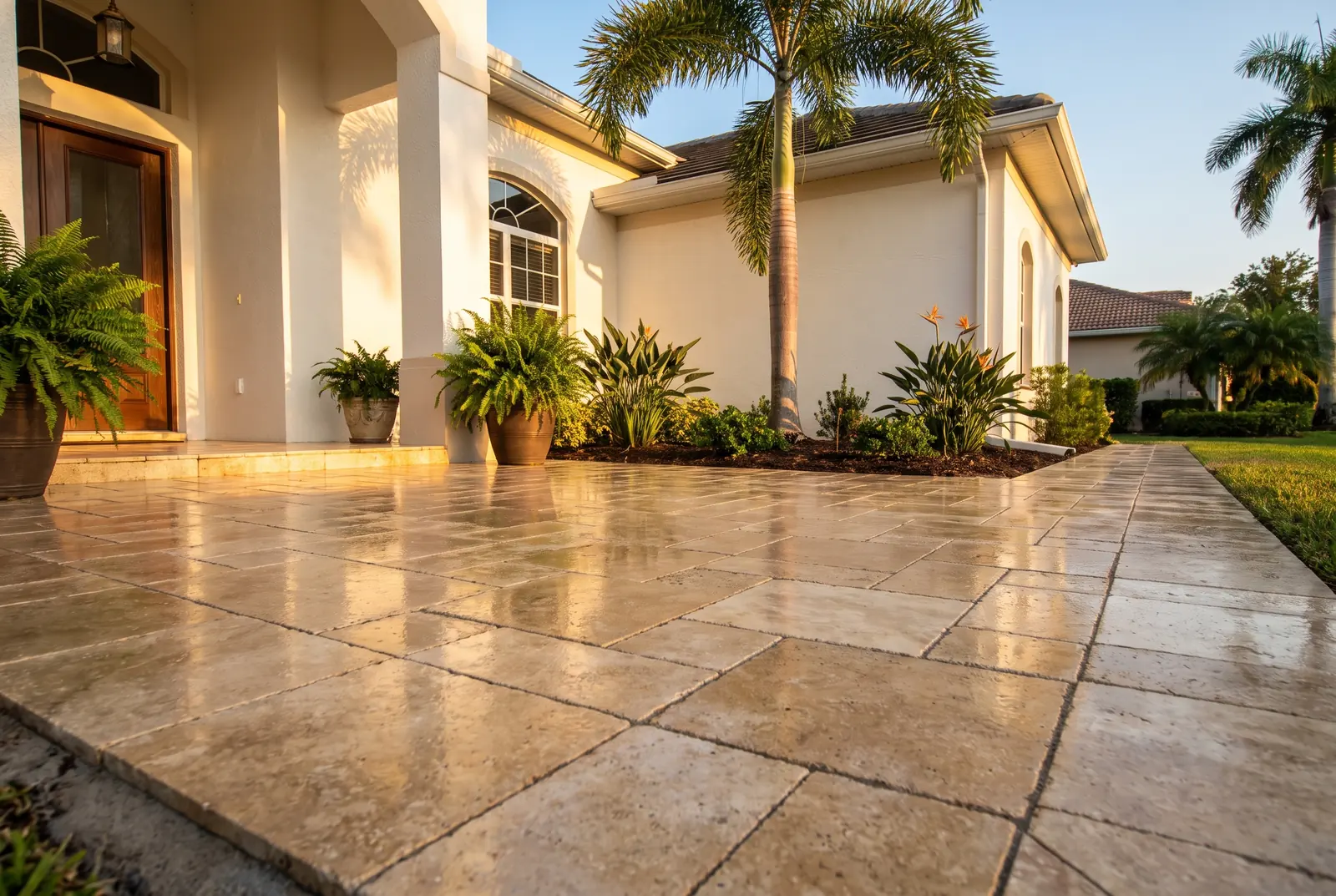
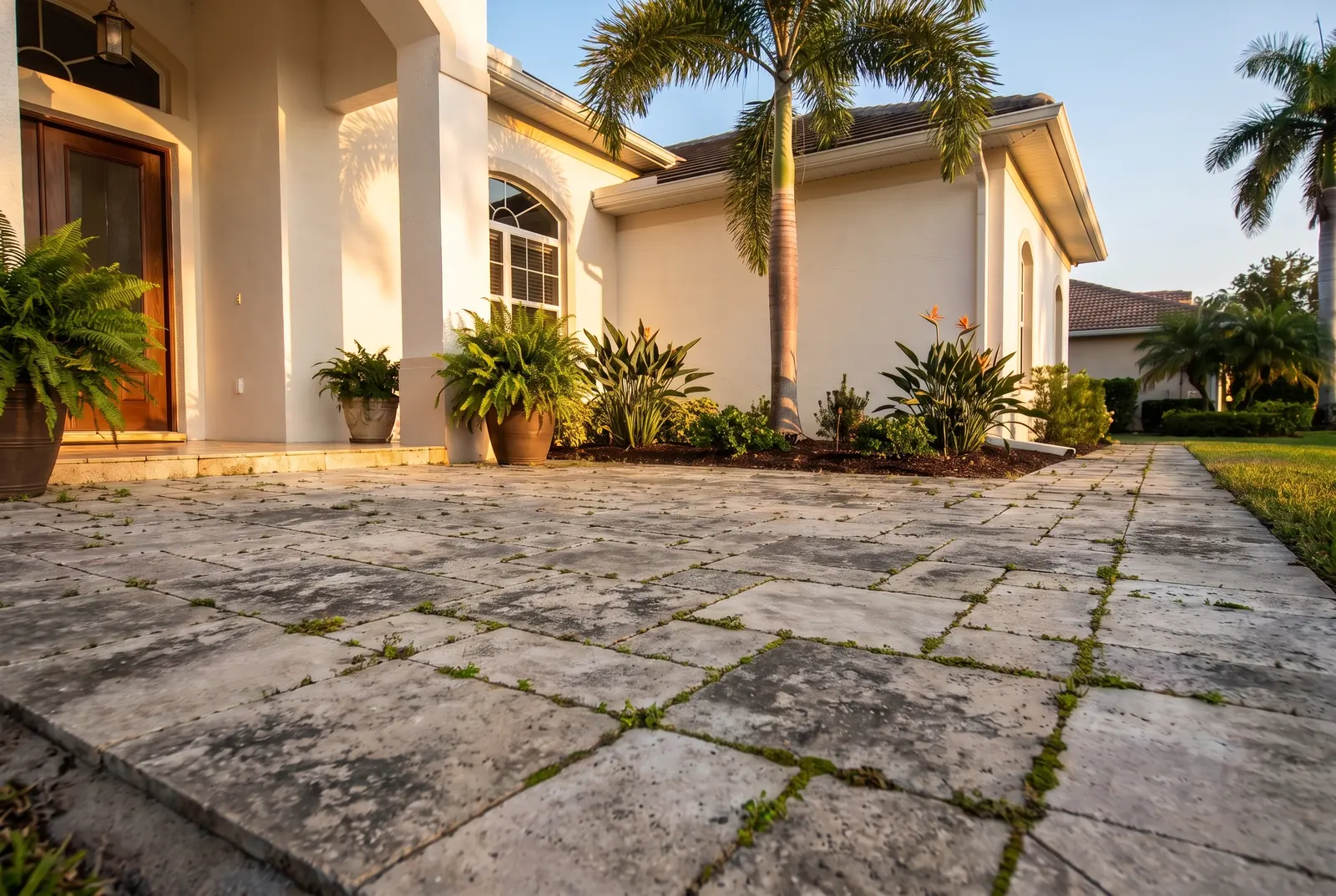
Freshly cleaned and sealed paver patio and walkway beside a white stucco home at golden hour, the stones warm with a satin sheen and crisp sand joints, ferns and a royal palm behind The same paver patio before cleaning, dull and dark with mildew, grime and weeds sprouting from the joints
Concept illustration: a paver patio before and after deep cleaning and sealing. Drag the line.

At a glance

Paver cleaning and sealing in Naples, FL, in one paragraph.

239 Exteriors deep-cleans pavers in Naples, Marco Island, Estero and Bonita Springs, removing dirt, grime, algae, mold and tough stains from driveways, patios, walkways and outdoor living spaces, then applies a premium sealant to protect against stains, UV damage and weed growth between joints. Estimates are free: call 239-500-WASH or send the form on this page. The rest of this page explains what a cleaning takes off and how the paver industry does it, how concrete pavers, travertine and brick differ, what a sealer does, why sealed pavers sometimes turn white or slippery, and the rules that apply in Naples.

Service
Deep cleaning, then protective sealing
Surfaces
Driveways, patios, walkways and outdoor living spaces
Removes
Dirt, grime, algae, mold and tough stains
Sealant applied to protect against
Stains, UV damage and weed growth between joints
Materials on this page
Concrete pavers, travertine and marble, clay brick
Where
Naples, Marco Island, Estero and Bonita Springs
Estimate
Free, by phone or the form

Paver Cleaning

What you get.

Deep cleaning

Removes dirt, grime, algae, mold, and tough stains to bring your pavers back to life.

Protective sealing

We apply a premium sealant to protect against stains, UV damage, and weed growth between joints.

From driveways to patios

We clean high-visibility hardscape areas that shape your property's curb appeal: driveways, patios, walkways, and outdoor living spaces.

Enhances value

Clean, sealed pavers boost curb appeal and help protect your investment.

The clean

What a paver cleaning removes, and how the trade does it

A paver cleaning takes off the dirt, grime, algae, mold and tough stains that make a driveway look older than the house. The industry's method for concrete pavers is written down in ICPI Tech Spec 5, “Cleaning, Sealing and Joint Sand Stabilization of Interlocking Concrete Pavement,” the technical note of the Interlocking Concrete Pavement Institute, now part of the Concrete Masonry and Hardscapes Association.

ICPI's procedure is chemistry first, water second. Efflorescence cleaners go on “with a low pressure pump spray 30 to 100 psi,” sit for the time the product calls for, and are rinsed with a high-pressure sprayer that runs “between 1,000 and 4,000 psi” at “between 2 and 6 gallons/minute.” The nozzle matters as well: “A nozzle that creates a wide spray enables a large area to be covered efficiently and prevents sand from being washed from the joints. A low angle of attack from a wide nozzle spray will also reduce the risk of dislodging joint sand.” And the finish is plain water: “The final rinse should be water only. A large amount of water is more important to rinsing than high pressure.”

Water alone is not a cleaning. Techniseal, a sealer manufacturer, answers the question directly in its product guide: “A simple water jet will not remove grease stains and will not dissolve efflorescence, a whitish salt that accumulates at the surface of pavers.” ICPI writes that many cleaners effective in removing dirt and efflorescence are “a mix of detergent and acid,” and warns that “cleaners with strong acids will change the color of the pavers slightly,” which is why “cleaners should be tried on a small area to test results and any color changes.” Work starts at the bottom of the pavement and runs up the slope in sections, because “by working up the slope, cleaning fluids will drain down the pavement,” and “sediment or cleaners allowed to pond in low spots may stain the pavers.”

Efflorescence: the white haze that is not dirt

ICPI: “Efflorescence is a whitish powder-like deposit which can appear on concrete products.” It forms when calcium hydroxide from the cement migrates to the surface and reacts with carbon dioxide in the air to make calcium carbonate. It “does not affect the structural performance or durability of concrete pavers.” It “may reach its peak in as short as 60 days after installation,” may “remain for months,” and some of it may wear away. When it needs removing, ICPI points to “a proprietary efflorescence remover” whose acid “is buffered and blended with other chemicals to provide effective cleaning without damage to the paver surface,” with the result checked “after letting the area dry for at least 24 hours.”

Surface by surface

Concrete pavers, travertine and brick: three materials, three rulebooks

The word “pavers” covers three materials on this page, and the chemistry that is right for one can etch another.

Concrete pavers

The ICPI rulebook

Interlocking concrete pavers tolerate the detergent-and-acid cleaners and the 1,000 to 4,000 psi rinse that ICPI describes, with the joint sand as the thing to protect.

ICPI adds site rules that matter in a Naples yard: “low tree branches, shrubs and vegetation adjacent to the pavement should be tied back or covered to protect from overspray of cleaning solutions or sealers,” and “turn off all automatic sprinkler systems during cleaning, sealing and drying.” Where an acidic cleaner might drain onto plants, “saturate the vegetation with water prior to using acidic cleaners.” Brushes, if any, are brass or plastic: “Scrub brushes with steel bristles are not recommended. They will loosen from the brush, rust, and leave stains.”

Travertine and marble

Mild, non-acidic cleaners

Travertine and marble are calcareous stones, a class the Natural Stone Institute's care guide is blunt about: “Calcium Carbonate is sensitive to acidic solutions so mild, non-acidic cleaners are recommended,” and “products containing lemon, vinegar or other acids may dull or etch calcareous stones.” For a pool deck or patio the instruction is specific: “In outdoor pool, patio or hot tub areas, flush with clear water and use mild bleach solution to remove algae or moss.” Abrasives are out too: “Scouring powders or creams often contain abrasives that may scratch certain stones.”

One correction from the institute: stone “sealers” are impregnators that “act as a repellent rather than a sealer,” and sealing makes stone more stain resistant, not stain proof.

Clay brick pavers

The 400 psi surprise

Clay brick carries a published pressure ceiling, and it sits below ICPI's concrete paver rinse range. The Brick Industry Association's Technical Note 20 on cleaning brickwork says: “Do not use water pressures higher than 400 psi (2800 kPa) as measured at the nozzle tip unless permitted by brick manufacturer,” with pre-wetting at “less than 100 psi,” chemical application at “maximum 30 to 50 psi” through a wide fan tip, and rinsing at “100 to 400 psi” with a fan tip “held a minimum of 12 in. (305 mm) from the brick surface.”

Chemistry is restricted as well: “Do not use unbuffered muriatic (hydrochloric) or hydrofluoric acid,” saturate the brickwork first and “keep wet until final rinse,” and “do not allow cleaning solution to dry on brickwork.” The note is written for clay brickwork and clay brick pavements, its own abstract says, and not for concrete pavers. Its governing line: “Select the gentlest effective cleaning method.”

Cleaning limits by paver material, from the material's own industry body

MaterialPressureChemistryAvoid
Concrete pavers (ICPI Tech Spec 5)Rinse at 1,000 to 4,000 psi with a wide fan nozzle at a low angle; efflorescence cleaners applied at 30 to 100 psiDetergent-and-acid blends, tested on a small area first; buffered efflorescence removersNarrow jets that dig out joint sand; cleaner left to pond in low spots; steel-bristle brushes
Travertine and marble (Natural Stone Institute)No published pressure figureMild, non-acidic cleaners; a mild bleach solution for algae and moss outdoorsLemon, vinegar or any acid; scouring powders; rust removers that carry hydrofluoric acid
Clay brick (Brick Industry Association TN 20)400 psi maximum at the nozzle unless the brick maker allows moreBuffered cleaners per the maker; pre-wet and keep wet until the final rinseUnbuffered muriatic or hydrofluoric acid; letting solution dry on the brick

The Natural Stone Institute's rust-remover warning: many contain trace hydrofluoric acid, which attacks every stone, granite and quartzite included.

Say what the surface is made of when you ask for an estimate. A travertine pool deck and a concrete paver driveway follow different rulebooks. The roof over that patio gets its own rules on the roof cleaning page.

Restore. Protect. Impress.

Sealing: what a sealer does, and the two families it comes in

After the deep clean, 239 Exteriors applies a premium sealant to protect against stains, UV damage and weed growth between joints. ICPI describes the mechanism: “Sealers reduce the intrusion of water, stains, oils and dirt into the paver surfaces,” and “most sealers change the appearance of the paver surface by darkening it and enhancing the surface color.”

Film-forming: the wet look

Acrylic sealers “can be solvent or water based. They enhance paver colors well and create a gloss on the surface. Acrylic sealers provide good stain resistance.” They “generally last for a few years” before re-coating, and “when they become soiled or worn, pavers with acrylics can be easily cleaned and resealed.” ICPI keeps them off “high abrasion areas such as industrial pavements or floors.” Urethanes “produce a high gloss and enhance the color of pavers.”

Penetrating: the natural look

Silane and siloxane sealers soak in rather than coat. “They initially enhance colors and produce a flat, no-gloss finish on the paver surface,” and they breathe: “A hydrophobic barrier to moisture is created, preventing moisture from entering but allowing the concrete to” breathe, as ICPI puts it, and release water vapor. Two ICPI lines read as if written for this coast: penetrating sealers give “additional protection of pavers subject to deicing salts or salt air,” and “they are also useful around pool decks to minimize degradation from chlorine.” Their limit: “Silanes and siloxanes do not resist penetration of petroleum stains unless they have additives specifically for that purpose.” Techniseal labels its (iN) Natural Look Protector “Penetrating: Will not make surfaces more slippery.”

ICPI also names what not to put on pavers at all: “Sealers not recommended for use with pavers are alkyds, esters, and polyvinyl acetates. Epoxies and silicones are generally not used on concrete pavers.” Which family suits your surface, gloss or flat, depends on the material, the traffic and the look you want, and it is settled in the estimate conversation.

The two sealer families, with the strengths and limits ICPI names

FamilyFinishStrengths ICPI namesLimits ICPI names
Acrylic (film-forming)Gloss, the wet look, colors enhancedGood stain resistance; easily cleaned and resealed when wornLasts a few years before re-coating; not for high-abrasion surfaces
Silane and siloxane (penetrating)Flat, no gloss, colors enhancedBreathable; extra protection against salt air; useful around pool decks against chlorineNo petroleum stain resistance without additives

Urethanes are the third film-former ICPI describes: high gloss and enhanced color.

Problems

Why sealed pavers turn white, cloudy or slippery, and how that is avoided

A sealer that turns white is usually a moisture story, and ICPI lists the four conditions behind it.

  • “The surface and joints are not dry.”
  • “The pavers have not had an adequate period of exposure to moisture,” which is the new-paver case: the concrete is still pushing out efflorescence.
  • “There is a source of efflorescence under the pavers (i.e, in the sand, base, or soil) moving through the joint sand and/or pavers.”
  • “The sealer is not breathable, i.e., does not allow moisture to move through to the surface of the paver and evaporate.”

Cloudiness has the same roots: “If the base under the pavers drains poorly, the sealer is applied to saturated sand in the joints, or is applied too thick, the sealer can become cloudy and diminish the appearance of the pavers. In this situation, the sealer must be removed or re-dissolved.” The prevention is in the preparation. ICPI: “The cleaned surface must be completely dry prior to applying most sealers. Allow at least 24 hours without moisture or surface dampness before application.” That one sentence is why, for most sealers, a clean and a seal are not the same afternoon, and why a wet-season storm can move a sealing day.

New pavers and the 60-day rule of thumb

You will read that new pavers must wait 60 or 90 days before sealing. ICPI publishes no such calendar. What it says is that efflorescence “may reach its peak in as short as 60 days after installation,” that sealing pavers that “have not had an adequate period of exposure to moisture” is one of the whitening causes above, and that if installation “takes place during dry period of the year, the next cycle of wet weather may sometimes be necessary for efflorescence to materialize.” The wait is a moisture condition; any fixed number of days is a particular paver or sealer maker's instruction, not an industry rule.

Slip

ICPI: “Be careful not to over apply the sealers such that the surface becomes slippery when cured,” and “adequate slip (foot) and skid (tire) resistance of concrete pavers should be maintained with properly applied joint sand stabilizer or surface sealers.” Slip-resistant additives exist as named products from sealer manufacturers, and ICPI says the sealer maker “should be consulted concerning slip and skid resistance performance characteristics under wet and dry conditions.” A pool deck is where the question gets asked, and it belongs in the estimate.

Drying, traffic and re-coating

ICPI: “Prevent all traffic from entering the area until the sealer is completely dry, typically 24 hours.” Techniseal's table for its paver protectors reads “Pedestrian: 24 hrs” and “Vehicular: 48 to 72 hrs,” so the cars stay off the driveway longer than feet stay off the walk. Wind matters too: for sprayed applications “the wind should be calm so that it does not cause an uneven application, or blow the sealer onto other surfaces.”

Re-coating is a matter of wear rather than a calendar. ICPI commits only to “reapplication after a period of wear and weather,” depending on “the use, climate, and quality of the sealer.” Techniseal is explicit that more is not better. Asked whether a fresh coat can go on every year, its guide answers “No,” explains that its protectors “are made to last several years,” that too much product applied too often “will create a buildup” that “could lead to the whitening and peeling of the film on the surface,” and that “normally, it is recommended to wait at least 2 or 3 years before recoating.” That is Techniseal's interval for its own products, not a universal one.

Joints and the wet season

Joint sand, weeds and the Naples rain

The joints are the weak point of a paver surface, and the wet season attacks them hardest.

239 Exteriors applies a premium sealant to protect against weed growth between joints. Of sealers in general, ICPI writes: “Like stabilizers, sealers are also useful in stopping unwanted insects and weeds.” Of the stabilizers themselves: “Joint sand stabilizers help secure sand in the joint after it has been installed. Their primary function reduces the risk of removal of joint sand from flowing water, wind, aggressive cleaning, tire action and intrusion of organic matter, seeds and insects.” Stabilization is “generally optional and not required for many interlocking concrete pavements,” but ICPI recommends it on slopes over 7 percent and, in a line that could have been written for this coast: “Pavements that see regular, heavy rainfall can benefit from stabilization of the joint sand. Surfaces that experience concentrated water flow such as gutters receiving sheet flow from large areas or at the drip lines under the eaves of buildings will better resist erosion of joint sand if stabilized.”

Regular, heavy rainfall is the Naples normal. NOAA's 1991 to 2020 climate normals for Naples Municipal Airport put 32.67 of the year's 49.55 inches between June and September, with August alone at 8.89 inches. November through February each average under 1.7 inches. Every month's average temperature sits above 65 F, so warmth is there all year; the rain decides how much water there is.

One ICPI line worth keeping: stabilizers “do not add to the structural (load bearing) capacity of the pavement.” In ICPI's terms, a sealer and a stabilizer reduce what gets into the surface and can help hold sand in the joints. They do not fix a base that has settled.

Rules

Water use, associations and the rules that apply in Naples

Two water rules and two statutes can come up on a paver job in Naples: the county's standing water rule, the water district's shortage plan, and the association statutes on appearance and on condominium maintenance.

The county allows exterior washing on any day. Under Collier County's Ordinance 2015-27, the Phase I restrictions that govern irrigation, “the washing of exterior home surfaces and roofs, shall be allowed anytime with the use of Low Volume Pressure Cleaning Equipment, Low Volume Mobile Washing Equipment and/or water hose equipped with an automatic self-canceling or automatic shutoff nozzle,” and “in all cases, the water used must drain to a pervious surface or to a water recycling/reuse system.” The county's summary does not state the ordinance's reach inside a city, and Estero and Bonita Springs lie outside the county; the city or the water utility can say which rule covers a given address.

During a declared water shortage a second rulebook applies. The South Florida Water Management District's Chapter 40E-21 phase text restricts “outside pressure cleaning” to “only low volume pressure cleaning” in every phase, and the same subsection says “washing or cleaning streets, driveways, sidewalks, or other impervious areas with water shall be prohibited.” The district's order declaring a phase can modify those restrictions, so the ones in force are the order's. Which line governs a paver driveway during a declared phase is a question for the district and the water utility at the time, and the district posts the current status on its landscape irrigation page.

For appearance, the association's declaration is the document that counts. Florida Statutes 720.3035(1)(a) limits an association's power to “enforce standards for the external appearance of any structure or improvement” to what is “specifically stated or reasonably inferred” in the declaration or its authorized guidelines, applied “reasonably and equitably” to all parcel owners. ICPI writes that most sealers darken the paver surface, and a film-forming sealer adds gloss, which is worth a look at the standards before the sheen is chosen. In a condominium, Florida Statutes 718.113(1) reads: “Maintenance of the common elements is the responsibility of the association, except for any maintenance responsibility for limited common elements assigned to the unit owner by the declaration.” Which walkways and pool decks that covers, and who orders the work, is a question for the declaration.

Terms

Paver Cleaning terms, defined.

The words the trade uses on this page, each in a sentence or two. More of the trade's terms are defined one per page in the glossary.

Efflorescence
A whitish, powder-like deposit on concrete pavers, formed when calcium hydroxide from the cement reaches the surface and becomes calcium carbonate. ICPI says it does not affect the paver's structural performance or durability, and that it may reach its peak in as short as 60 days after installation.
Film-forming sealer
A sealer that cures as a film on the surface: acrylics and urethanes, which give the gloss of the wet look. ICPI writes that acrylics give good stain resistance and generally last a few years before re-coating; urethanes, it adds, “cannot be rejuvenated simply by re-coating.”
Penetrating sealer
A silane or siloxane sealer that soaks into the paver and cures inside its pores. Flat finish and breathable; ICPI writes that it gives additional protection against salt air and is useful around pool decks to minimize degradation from chlorine.
Wet look
The darkened, glossy finish a film-forming sealer gives pavers, as if they had just been rinsed. Most sealers darken and enhance color to some degree; the gloss is the acrylic and urethane signature.
Joint sand stabilizer
A product that helps secure the sand in paver joints; in ICPI's words, it reduces the risk of removal of joint sand from flowing water, wind, aggressive cleaning, tire action and intrusion of organic matter, seeds and insects. It adds nothing to load-bearing capacity.
Polymeric sand
Joint sand blended with polymer binders that stiffen when water is applied to the joint. The name is the makers'; ICPI's Tech Spec 5 does not use it, and describes its dry stabilizers as organic, inorganic or polymer compounds activated by water.
Calcareous stone
Stone made mostly of calcium carbonate: travertine, marble, limestone. Sensitive to acid, so the Natural Stone Institute calls for mild, non-acidic cleaners on it.
Travertine
A calcareous natural stone used for pool-deck and patio pavers. Acid may dull or etch it, so it is cleaned with mild, non-acidic cleaners and, outdoors, a mild bleach solution for algae and moss.
Impregnator
What the stone industry sells as a sealer: a product that soaks into stone and acts as a repellent. It makes stone more stain resistant, not stain proof.
Dry time
The wait between a cleaning and a sealing, and between a sealing and traffic: at least 24 hours without moisture before most sealers go on, and typically 24 hours before traffic returns, per ICPI.

FAQ

Paver Cleaning questions

More questions are answered one per page in the answers.

Do you seal pavers after cleaning them?

Yes. After the deep clean, a protective sealant can be applied to guard against stains, UV damage and weed growth between joints. Ask for sealing when you request your estimate.

Which paver areas do you clean?

Driveways, patios, walkways, and outdoor living spaces: the high-visibility hardscape areas that shape your property's curb appeal.

How do I get a paver cleaning estimate?

Call 239-500-WASH or send the estimate form on this page, and 239 Exteriors will follow up with a free estimate.

Why did my paver sealer turn white or milky?

ICPI lists four causes: the surface and joints were not dry, the pavers had not had enough exposure to moisture before sealing, efflorescence under the pavers is moving up through the joints, or the sealer is not breathable. A cloudy sealer has the same roots, plus a poorly draining base or a coat applied too thick, and ICPI's answer for it is that the sealer must be removed or re-dissolved, with the sealer supplier consulted for advice on treating it.

How long after cleaning can pavers be sealed?

For most sealers, not on the day of the cleaning. ICPI says the cleaned surface must be completely dry before most sealers go on, with at least 24 hours without moisture or surface dampness. In the wet season that wait can stretch, since an afternoon storm resets the clock.

How long before I can walk or drive on sealed pavers?

ICPI says to keep all traffic off until the sealer is completely dry, typically 24 hours. Techniseal's table for its own paver protectors gives 24 hours for foot traffic and 48 to 72 hours for vehicles.

Wet look or natural look, which should I pick?

They are two chemistries, not two grades. Acrylic film-formers give the gloss and the darker wet look with good stain resistance; silane and siloxane penetrating sealers leave a flat, natural finish, breathe, and ICPI writes that they add protection against salt air and are useful around pool decks to minimize degradation from chlorine. Techniseal labels its (iN) Natural Look Protector as one that will not make surfaces more slippery. The material, the traffic, the pool and the association's standards decide it, in the estimate conversation.

How often should pavers be resealed in Naples?

ICPI commits only to reapplication after a period of wear and weather, depending on the use, the climate and the quality of the sealer. Techniseal says a fresh coat every year is too often for its protectors, which are made to last several years, and recommends waiting at least 2 or 3 years before recoating. Neither sets an interval for every sealer.

Should travertine be cleaned the same way as concrete pavers?

No. Travertine is a calcareous stone, and the Natural Stone Institute says calcium carbonate is sensitive to acid, so it recommends mild, non-acidic cleaners, with a mild bleach solution for algae and moss outdoors. Concrete pavers tolerate the detergent-and-acid cleaners ICPI describes; on calcareous stone such as travertine, the institute warns that acids may dull or etch. Say which you have when you ask for an estimate.

Will sealing make my pool deck slippery?

It can if the sealer is over-applied; ICPI says so directly. Two options appear on this page: a penetrating sealer with a flat finish, such as the (iN) Natural Look Protector Techniseal labels as not making surfaces more slippery, or a slip-resistant additive in a film-forming sealer, with the sealer maker consulted on wet and dry slip resistance. Ask for the pool deck to be treated as its own question in the estimate.

Do I need to wait 60 or 90 days before sealing new pavers?

The number is a rule of thumb, not an ICPI rule. ICPI says efflorescence may peak in as short as 60 days after installation and that sealing pavers before they have had adequate exposure to moisture is one cause of whitening. The wait is about moisture; any fixed count of days comes from a particular paver or sealer maker's instructions.

Can pavers be pressure washed?

Concrete pavers can, within ICPI's 1,000 to 4,000 psi range and with a wide fan nozzle at a low angle so the joint sand stays put. Clay brick is capped at 400 psi at the nozzle by the Brick Industry Association unless the brick maker allows more. The Natural Stone Institute publishes no pressure figure for travertine; its rule is about chemistry. Pressure alone is not a cleaning: it will not dissolve efflorescence or lift grease, and ICPI's procedure puts the cleaner before the rinse.

Can pavers be cleaned during water restrictions?

Where the county's standing rule, Ordinance 2015-27, applies, exterior washing is allowed any day with low-volume pressure cleaning equipment or a hose with a self-canceling nozzle, as long as the water drains to a pervious surface or a recycling system. During a declared water shortage the South Florida Water Management District's Chapter 40E-21 applies, and its phase text both restricts outside pressure cleaning to low-volume equipment and prohibits washing impervious areas with water; that is confirmed with the district and the utility at the time.

Will sealing make old, faded pavers look new?

Cleaning removes what sits on the surface; most sealers darken and enhance the color that is left, in ICPI's words. Wear and sun fade are in the paver itself, and a sealer does not put pigment back. The before and after pair at the top of this page is a concept rendering, labeled as such, not a promise about a particular driveway.

Do weeds come back after sealing?

239 Exteriors applies a premium sealant to protect against weed growth between joints. ICPI writes that, like stabilizers, sealers are useful in stopping unwanted insects and weeds.


Sources

Where this page's facts come from.

Every technical statement above is drawn from one of these documents. Nothing on this page about 239 Exteriors goes beyond what the company itself states.

  1. Interlocking Concrete Pavement Institute (now part of the Concrete Masonry and Hardscapes Association). Tech Spec 5, Cleaning, Sealing and Joint Sand Stabilization of Interlocking Concrete Pavement, revised February 2018 (the edition quoted here)
  2. Concrete Masonry and Hardscapes Association. PAV-TEC-005-22, the 2022 revision of Tech Spec 5 as cataloged by CMHA, whose wording differs in places from the 2018 edition quoted above
  3. Techniseal. Product Guide 2024 (paver protectors, downtimes, the recoating answer)
  4. Natural Stone Institute. Stone Care, consumer guide
  5. Brick Industry Association. Technical Note 20, Cleaning Brickwork, August 2018
  6. NOAA National Centers for Environmental Information. U.S. Climate Normals 1991 to 2020, station USW00012897, Naples Municipal Airport (data query)
  7. Collier County 311. Phase I Water Restrictions (Ordinance 2015-27), the county's summary
  8. South Florida Water Management District. Chapter 40E-21, Florida Administrative Code, Water Shortage Plan (PDF), and the district's current restriction status
  9. Florida Legislature. Florida Statutes 720.3035, Architectural control covenants (2026)
  10. Florida Legislature. Florida Statutes 718.113, Maintenance of condominium common elements (2026)

Page reviewed September 27, 2026. Florida statutes are quoted from the 2026 Florida Statutes; every image on this page is a labeled concept illustration, not a photograph of a completed job.

How it works

The method, in plain language.

The sequence

How paver sealing works

Clean, then a drying condition, then the sealer. What ICPI and the sealer makers publish about each step.

Read it

Answers

Exterior cleaning answers

One question per page, answered from the documents that govern a roof, a paver surface or a pane of glass.

Read it

Glossary

Exterior cleaning glossary

Roof, paver, glass and Florida rule terms, each defined on its own page in the sense its publisher uses.

Read it

Also from 239 Exteriors

The other two surfaces.

Choose more than one service on the form and the roof, the pavers and the windows get quoted together. All of it in Naples, Marco Island, Estero and Bonita Springs, the service area, and the contact page takes any question.

Soft wash

Roof Cleaning in Naples, FL

Safe soft-wash cleaning that removes algae, mold and stains without damaging your roof.

See the service

Exterior glass

Window Cleaning in Naples, FL

Exterior window cleaning that removes dirt and buildup for a clearer view and a brighter home or business.

See the service

Free estimate

Ask about your pavers.

Call 239-500-WASH, or send the form with the service preselected and 239 Exteriors will follow up.

239-500-WASH(239) 500-9274

Free estimate

Request a free paver cleaning estimate

Paver Cleaning is already selected below. Add anything about the property that helps.

Prefer to talk? Call 239-500-WASH. See the privacy policy.

Ask a question