
The standard
How exterior glass gets cleaned
What the glass makers say has to be known about a pane before anything touches it.
Read it
Free estimates
Call 239-500-WASH Free estimate Ask a questionNaples, Marco Island, Estero and Bonita Springs, FL
The sequence
A sealer is the last step in a sequence, and the steps before it decide how the surface looks a year later. This page follows that sequence in the words of the institute and the manufacturers who publish it.
At a glance
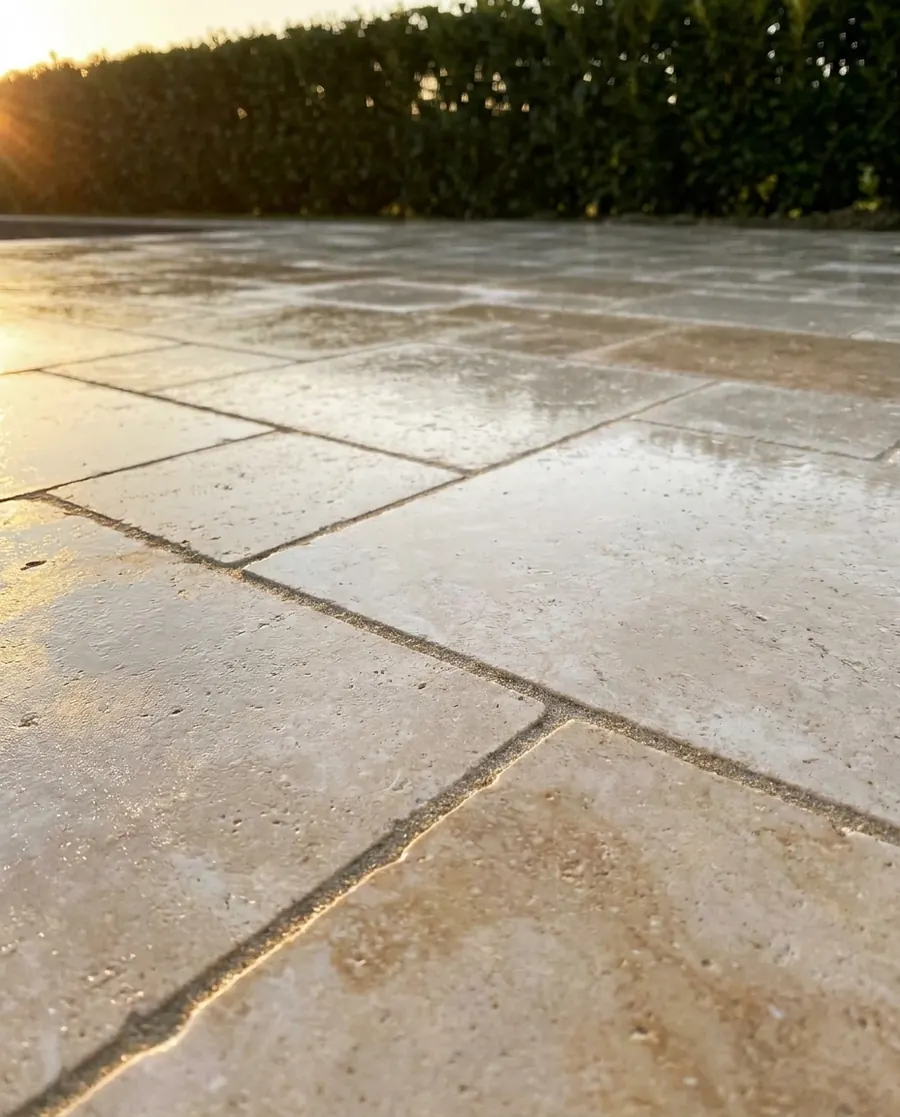
Sealing pavers is a sequence with a condition attached to each step. The trade's own documents put cleaning first, and Techniseal is explicit that cleaning means a chemical cleaner, not water alone. Between the clean and the seal they put a drying condition: ICPI asks for at least 24 hours without moisture or surface dampness, and SEK-Surebond publishes the same 24 hours as numbered site preparation steps. Only then does a sealer go on, and it is not finished when it looks finished: the conditions run through the cure, and which sealer it is decides what happens when the finish wears.
The sequence
A sealer does not correct the surface it goes onto. What is on the pavers when it is applied is what stays visible afterwards: the milky patch, the dull spot, the dirt that looks like it sits under the finish are conditions rather than products, and the trade's own documents treat each of them as a condition that was not met.
SEK-Surebond puts the consequence flatly in its site preparation bulletin: “If this process is skipped; any dirt, spots and residue on the substrate will be sealed in and make for an unsightly look and also could effect optimal performance of the sealer.” The semicolon and the spelling of effect are the bulletin's own. It fixes whatever is on the surface in place.
Between the cleaning and the sealing sits a condition, and it is a condition rather than a date. ICPI Tech Spec 5, “Cleaning, Sealing and Joint Sand Stabilization of Interlocking Concrete Pavement,” revised February 2018, asks for at least 24 hours without moisture or surface dampness before application. It is written about most sealers, not all, and about moisture, not a calendar.
A date can be counted off in advance; a condition has to be met on the day. Which days are likely to offer it is a question about the calendar, set out month by month, and what happens when it is missed is under why sealed pavers turn white.
Step one
Water is the rinse, not the cleaning. Asked in its own product guide whether cleaning pavers with a water jet is enough before a sealer goes on, Techniseal answers: “No. Always use a cleaner to clean pavers thoroughly.”
Its reason is what water cannot reach: grease will not rinse off, and efflorescence is a salt that has to be dissolved. Techniseal's full sentence on that, and ICPI's description of what a paver cleaner is made of, are quoted under what a paver cleaning removes. The cleaner does the work; the water rinses it away.
Which cleaner is a decision inside the procedure, not a default. SEK-Surebond writes it into its numbered steps: “If efflorescence is present on surface use an efflorescence cleaner in place of general purpose cleaner.” Where that cleaner carries acid, two bodies arrive at one principle from opposite ends. ICPI explains why a proprietary product is specified: the acid in it is buffered and blended with other chemicals. The Brick Industry Association instructs cleaners of clay brickwork not to “use unbuffered muriatic (hydrochloric) or hydrofluoric acid”, because, in its words, use of unbuffered high-strength acid solutions “tends to cause further stains and damage mortar joints.” Two materials, two documents, and neither of them writes a universal rule.
Pressure comes last, and every published figure belongs to the material it was written for. ICPI's professional range for interlocking concrete pavement is a sprayer applying “cleaner and water between 1,000 and 4,000 psi”. The Brick Industry Association's Technical Note 20, whose own abstract says it addresses the cleaning of brickwork and brick pavements, caps clay far lower: “Do not use water pressures higher than 400 psi (2800 kPa) as measured at the nozzle tip unless permitted by brick manufacturer”. Both ladders run rung by rung under the pressure limits each paver material carries, and on runoff BIA says only to “treat runoff in accordance with the requirements of the jurisdiction”: the water rules that apply in Naples are on the service page.
Corroboration
One document making a claim is an assertion. Two independent documents publishing the same condition is how a trade practice shows itself, and the condition ICPI states in a sentence, SEK-Surebond publishes as numbered steps.
Technical Bulletin TB.6, “Site Preparation Before Sealer Application,” runs the preparation as a list. Step 7 is one line: “Let dry for a minimum of 24 hours.” Step 12 returns to it: “it is highly recommended that the surface be free from any moisture/rain/water for a minimum of 24 hours prior to the application of most sealers.” Both documents hedge the same way, on most sealers rather than all.
The bulletin also settles, for its own products, whether joint sand goes in before the sealer or after it. It publishes both orders, each with a drying condition attached: polymeric sand may be installed after the sealer “has properly cured for 24 - 48 hours”, or before it, in which case “be sure surface is dry for 24 hours before applying sealer.”
SEK-Surebond's polymeric sand data sheet is stricter still about water. PolySweep, revision 6.7.23, tells installers to “make sure pavement joints and surface are completely dry AND there is no rain forecasted for at least 12 hours after installation”. The capitalized AND is the sheet's own. That is a different number for a different product, and it is the point: each material in the sequence carries its own weather window, published by whoever makes it.
The choice
Sealers are commonly sorted into two families, film-forming and penetrating. A second axis sits underneath that one and decides how deep the product ends up: what the sealer is carried in.
ICPI describes both carriers plainly. Solvent based products “carry the dissolved solids as deep as the solvent will penetrate into the concrete paver”, and “After the solvent evaporates, the sealer remains.” Water based sealers are “emulsions, or very small particles of the sealer dispersed in water”, and they “penetrate concrete as far as the size of the particles will permit”. One is bounded by how far a liquid soaks in, the other by how small a particle is.
What the choice costs shows up much later. Of acrylics, Tech Spec 5 writes that “When they become soiled or worn, pavers with acrylics can be easily cleaned and resealed without the use of extremely hazardous materials.” Of urethanes: “Urethanes cannot be rejuvenated simply by re-coating.” Two film-forming products can look alike on the first afternoon and give different answers once the finish is worn. The finishes each family produces are compared under the two sealer families.
How often any of it is redone is a question about wear rather than a calendar. ICPI publishes no resealing schedule, committing only to reapplication after a period of wear and weather, and hedging even the service life of an acrylic as a few years before re-coating is required; the manufacturer numbers that sit beside that condition are quoted under how often a sealer is re-coated.
The limits
The sealer goes on outdoors, through a sprayer, in whatever weather the day supplies, and ICPI's application warnings are about those three facts.
On the equipment: “If spraying sealer on the pavers, care should be taken to prevent the spray nozzle from clogging and causing large droplets to be unevenly distributed on them.” ICPI adds that this “is most important for water based sealers”. Wind, over-application and the wait before traffic returns are three more conditions it attaches to the day. And what follows the spraying is a cure rather than a finish: water based sealer curing time, ICPI writes, “will vary with the temperature, wind conditions and humidity”.
The word sealer does not mean the same thing on every surface, either. The Natural Stone Institute writes that “Sealing does not make the stone stain proof, rather it makes the stone more stain resistant.” That is stone, not concrete, and concrete pavers, travertine and brick each get their own rulebook. ICPI's verb for a concrete paver is the same kind of verb: a sealer reduces intrusion rather than stopping it.
Terms
The words the trade uses on this page, each in a sentence or two. More of the trade's terms are defined one per page in the glossary.
The surface has to be clean and dry. ICPI sets the condition as at least 24 hours without moisture or surface dampness, and SEK-Surebond publishes the same 24 hours at step 7 and again at step 12 of its site preparation bulletin. Both write about most sealers rather than all.
SEK-Surebond answers in one sentence: skip the preparation and dirt, spots and residue on the substrate will be sealed in and make for an unsightly look. Techniseal adds that a simple water jet will not remove grease stains and will not dissolve efflorescence.
The trade publishes both orders, each with its own drying condition. SEK-Surebond's site preparation bulletin says polymeric sand may go in after the sealer has cured for 24 to 48 hours, or before it, in which case the surface has to be dry for 24 hours first.
Many cleaners effective in removing dirt and efflorescence are, in ICPI's words, a mix of detergent and acid, and ICPI specifies proprietary products in which that acid is buffered and blended with other chemicals. The Brick Industry Association rules out unbuffered muriatic and hydrofluoric acid on clay brickwork, because such solutions tend to cause further stains and damage mortar joints.
It changes how deep the sealer goes and how long the day runs. ICPI writes that a solvent carries the dissolved solids as deep as it penetrates and then evaporates, that water based sealers are emulsions limited by particle size, and that their curing time varies with the temperature, wind conditions and humidity.
That depends on the chemistry. ICPI writes that worn acrylics can be easily cleaned and resealed, and that urethanes cannot be rejuvenated simply by re-coating. On timing it commits only to reapplication after a period of wear and weather, depending on the use, climate and quality of the sealer. ICPI's only figure is its own hedge, that an acrylic generally lasts a few years before re-coating is required; any firmer interval belongs to a named maker.
Tech Spec 5's application guidance warns about four of them: a clogging nozzle leaving large droplets, wind blowing the sealer onto other surfaces, over-application leaving a slippery surface once cured, and traffic before the sealer is completely dry.
Sources
Every technical statement above is drawn from one of these documents. Nothing on this page about 239 Exteriors goes beyond what the company itself states.
Page reviewed September 14, 2026. Florida statutes are quoted from the 2026 Florida Statutes; every image on this page is a labeled concept illustration, not a photograph of a completed job.
Keep reading
The standard
What the glass makers say has to be known about a pane before anything touches it.
Read itWhat we do
What each of the three services covers, in the company's own words, and where an exterior cleaner's job stops.
Read itFree estimate
Call 239-500-WASH, or send the form and 239 Exteriors will follow up.
Free estimate
Tell us which surface you are asking about and anything about the property that helps.
Request received
Your request is in. 239 Exteriors will follow up with a free estimate. Need to reach us sooner? Call 239-500-WASH.
The form did not send
Nothing was lost, but this request did not go through. Call 239-500-WASH and we will take the details by phone, or try the form again in a moment.
Request received
Your request is in. 239 Exteriors will follow up with a free estimate. Need to reach us sooner? Call 239-500-WASH.
The form did not send
Nothing was lost, but this request did not go through. Call 239-500-WASH and we will take the details by phone, or try the form again in a moment.