239 Exteriors

Soft wash

Roof Cleaning in Naples, FL

Professional roof cleaning removes organic buildup while helping protect the look of your home. 239 Exteriors uses a soft-wash method that removes algae, mold and stains without damaging your roof.

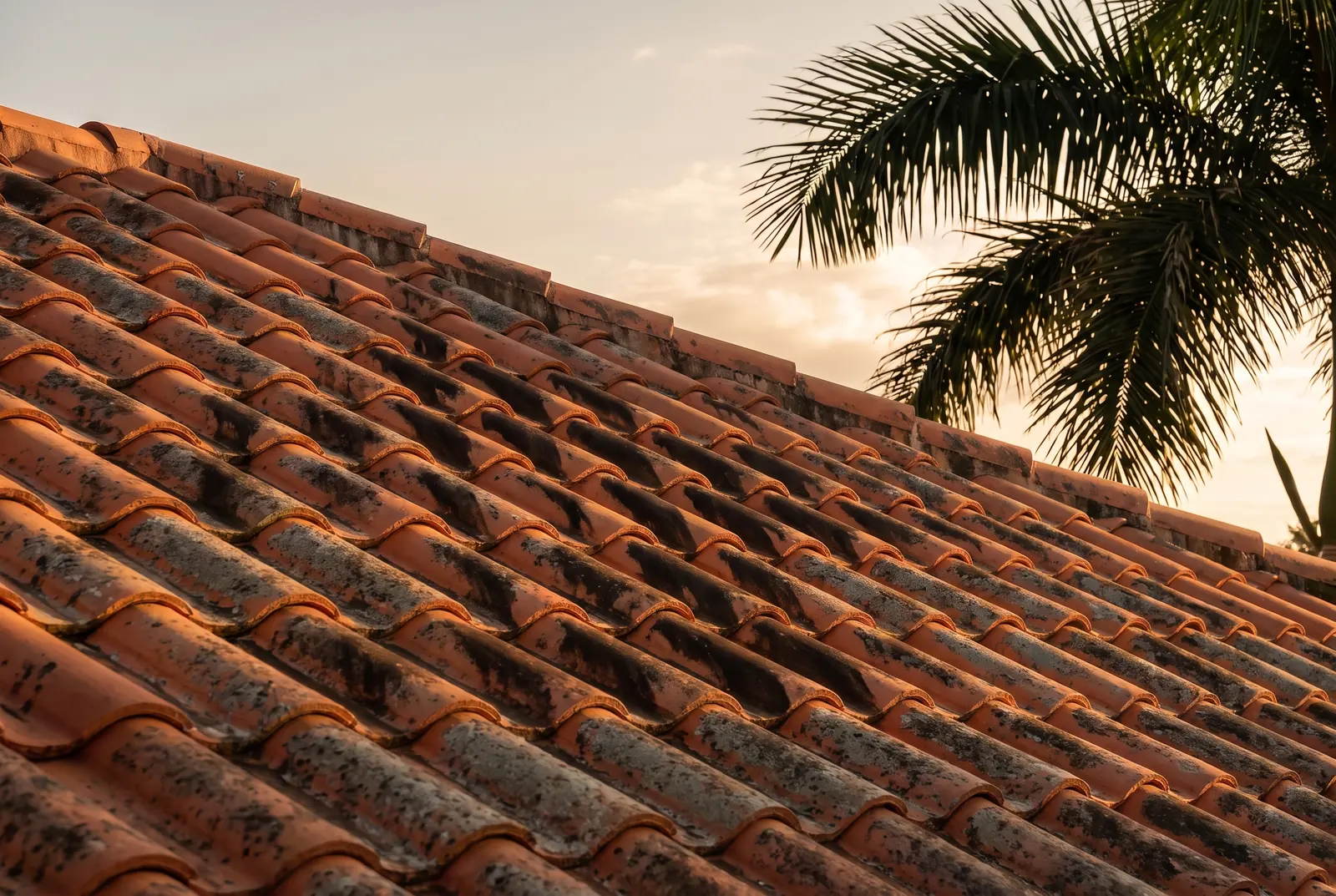
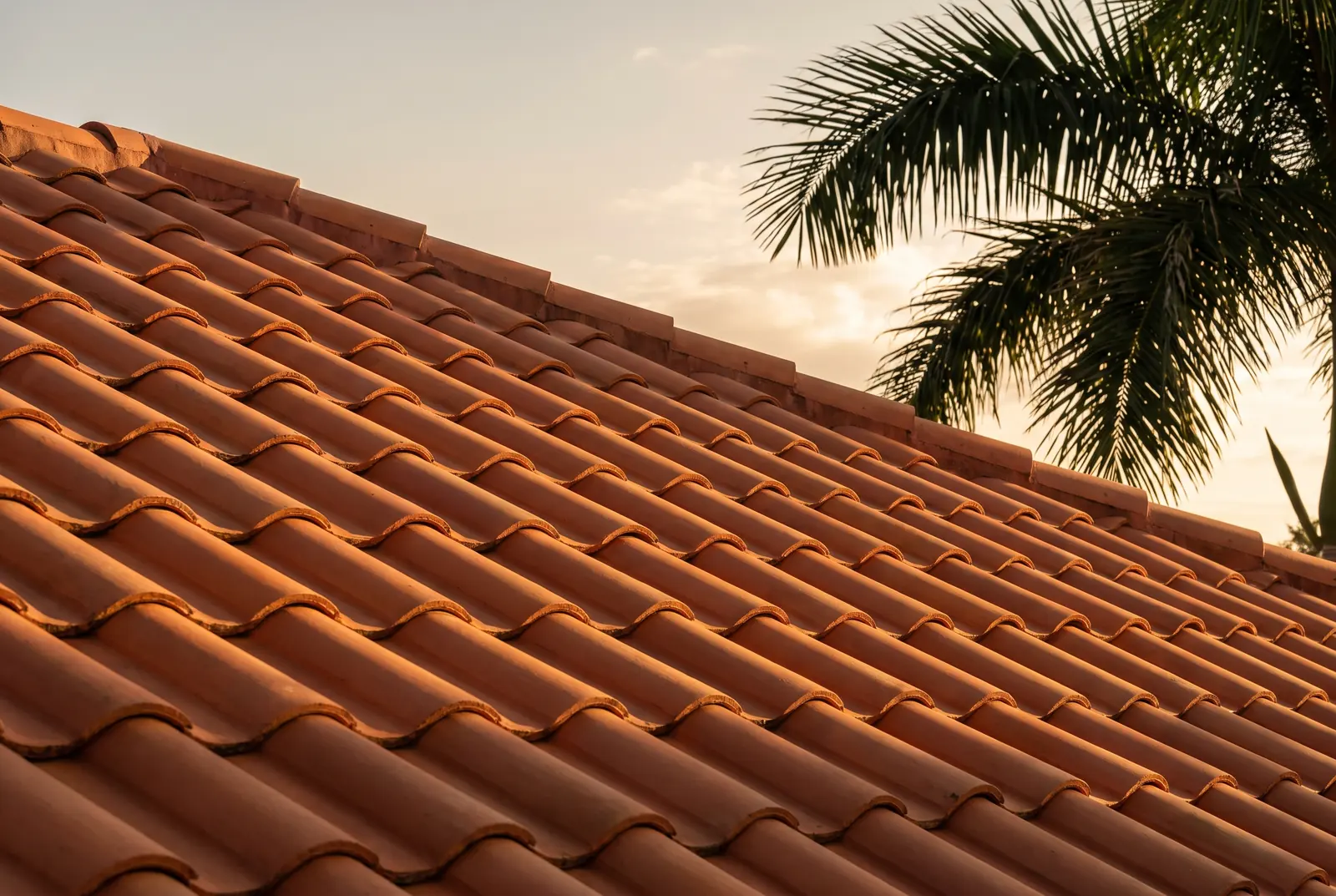
Close-up of a freshly cleaned terracotta barrel-tile roof at golden hour, uniform warm orange tiles with the ridge running diagonally and a royal palm frond against the sky The same roof before cleaning, the barrel tiles streaked black with algae and blotched with gray-green mildew
Concept illustration: a barrel-tile roof before and after a soft-wash cleaning. Drag the line.

At a glance

Roof cleaning in Naples, FL, in one paragraph.

239 Exteriors cleans roofs in Naples, Marco Island, Estero and Bonita Springs with a soft wash: low pressure and a cleaning solution that removes algae, mold and stains without damaging your roof. Estimates are free, by phone at 239-500-WASH or through the form on this page. The rest of this page explains what the dark streaks are, what the roofing trade's own bulletins say about pressure washing, what the makers of tile, shingle and metal roofs say about cleaning them, and which Florida rules touch the job.

Service
Soft-wash roof cleaning
Removes
Algae, mold and stains: the organic buildup that makes a roof look aged
Method
Low pressure plus a cleaning solution (a soft wash)
Roofs on this page
Concrete and clay tile, asphalt shingle, metal
Where
Naples, Marco Island, Estero and Bonita Springs
Estimate
Free, by phone or the form

Roof Cleaning

What you get.

Restore curb appeal

Lift the dark organic buildup that can make a roof look aged and neglected.

Safe soft-wash cleaning

Removes algae, mold and stains without damaging your roof.

A thoughtful approach

We focus on a thorough exterior clean suited to your property and roofing materials.

Clear service details

Call 239-500-WASH to discuss your roof cleaning needs and request service.

The stain

What are the black streaks on a Naples roof?

The dark streaks are a living film, mostly algae, and the roofing industry names the organism. The Asphalt Roofing Manufacturers Association (ARMA) writes that Gloeocapsa magma “is probably the most prevalent of several algae species that contribute to discoloration.”

ARMA describes what you see: “Natural pigments produced by these algae may cause white or light-colored roofs to gradually turn dark brown or black. Discoloration may appear uniform or as streaks.” The same bulletin says where it is worst: “Algae discoloration of roofs is most widespread in the Gulf States and along the Northwest and Eastern Seaboards.” Naples is on the Gulf.

GAF's technical advisory bulletin on blue-green algae staining explains the mechanics. Blue-green algae “requires moisture and proper temperatures to grow,” dew is “the primary moisture source,” the spores travel by air from one roof to the next, and the dark color is “a protective sheath” the organism makes against ultraviolet light. GAF adds that blue-green algae “generally grows on the northern exposures of the roof since this exposure generally receives less sunlight.”

On tile, the growth sits on a film of dust

The Tile Roofing Industry Alliance (TRI Alliance) makes a point that matters in barrel-tile neighborhoods: “Mildew, algae and moss do not grow directly on tile but on the accumulation of dust and other organic materials that settle on tile. With enough cycles of heat, moisture and light, spores start to grow.” That film is what a cleaning takes off.

Algae, moss or tree droppings

ARMA separates them: “The algae discolorations should not be confused with moss or tree droppings, which typically produce only localized discoloration.”

The method

Why a roof gets a soft wash, not a pressure wash

A soft wash cleans with chemistry and time instead of force. SoftWash Systems defines it this way: “Unlike traditional pressure washing, which uses high-pressure water to blast away dirt and grime, soft washing uses a low-pressure spray and specialized cleaning solutions.” Those solutions “target organic stains, like mold, mildew, and algae, breaking them down”.

That is the method 239 Exteriors uses: a safe soft-wash cleaning that removes algae, mold and stains without damaging your roof.

What the roofing makers say about pressure

  • Asphalt shingle. ARMA is absolute: “Never use a pressure washer to clean an asphalt shingle roof”, and it names the consequence in the same sentence: granule loss, and very likely premature failure of the roof system. Even friction is a problem: “Avoid scrubbing the surface, as this friction may loosen and remove granules.”
  • Metal. The Metal Roofing Alliance's cleaning guide says “NEVER use a power washer,” and rules out “steel wool, wire brushes, scouring powders, paint removers or thinners.”
  • Concrete tile. Eagle Roofing Products, a concrete roof tile manufacturer, writes that a cleaning should “use only water with the water pressure never exceeding 1200 pounds per square inch (psi),” with a cleaner added only when the roof calls for it and then “only in the most diluted solution possible.”

Shingle loses the granules that protect it, the Metal Roofing Alliance's guide forbids a power washer outright, and tile can be etched by the wrong chemistry: Eagle warns that some cleaning products “can affect the PH of the tile or even etch the surface.” The pressure numbers belong to the surfaces they were written for. Eagle's 1200 psi is a ceiling for concrete tile, not a target, and it does not transfer to shingle or metal.

Dwell, rinse, and no brushes

For asphalt shingle, ARMA's own procedure is a solution of “liquid household bleach (sodium hypochlorite) and water,” left on the roof “for at least 15 minutes but no more than 20 minutes,” then rinsed “by gently spraying the surface with water.” No power washer, and no “brush or broom.” ARMA also cautions that mixing directions “may vary among shingle manufacturers,” so a bleach ratio is the shingle maker's call rather than a universal number. Tile and metal follow their own makers' instructions; the shingle recipe does not carry over.

Surface by surface

Tile, shingle and metal: what each maker says about cleaning it

Barrel tile, asphalt shingle and metal each come with cleaning instructions written by the people who make them, and the instructions differ. This is what they say.

Concrete and clay tile

Water first, chemistry sparingly, feet off the tile

Eagle's default is water alone at no more than 1200 psi. “Depending upon how dirty a roof appears and what pollutant is on the roof, it may be necessary to use a cleaner in conjunction with the pressurized water, but only in the most diluted solution possible.”

The bigger risk on tile is weight. Eagle: “Walking on or putting pressure on tiles can potentially cause damage. Our recommendation is to stay off your roof.” TRI Alliance gives the technique for anyone who must: step “on the bottom three inches of the installed tile,” keep the feet horizontal, spread weight on “the high points of adjacent tiles” on S-profile tile, and “avoid walking on hips or valleys.” A broken tile is not cosmetic: it “may cause problems by allowing water and UV rays to penetrate through to the underlayment and damage it.”

Asphalt shingle

Chemistry and dwell time do the work

ARMA's bulletin is the rulebook: a sodium hypochlorite and water solution, 15 to 20 minutes of dwell, a gentle rinse, and no pressure washer, brush or broom, because friction removes the granules that protect the asphalt. ARMA “encourages the use of professionals when attempting to clean shingles.”

If the roof is due for replacement anyway, ARMA notes that algae-resistant shingles exist, “specifically designed to inhibit algae growth for extended periods of time.” ARMA's bulletin on algae and moss prevention adds that retrofitting zinc or copper strips to an existing roof “is not recommended,” because the strips need exposed nails or a broken sealant bond.

Metal

Mild detergent, soft tools, no power washer

The Metal Roofing Alliance keeps it simple: “1/4 cup of mild detergent (including mild laundry detergents, car washing soap or dish soap) per gallon of water,” left to “stand for 5 to 10 minutes, before thoroughly rinsing the surface with plain water.” Nothing abrasive, and “NEVER use a power washer.”

Its last line is the one that protects you: “Always follow the manufacturer's specific instructions to help protect and maintain roof warranties.”

The makers' cleaning limits, side by side

Roof materialPressureChemistry the maker namesNever
Concrete tile (Eagle Roofing Products)Water only, never above 1200 psiA cleaner “only in the most diluted solution possible,” compatible with concreteFoot traffic without need; products that change the tile's pH or etch it
Asphalt shingle (ARMA)No pressure washer; a gentle rinseHousehold bleach (sodium hypochlorite) and water, 15 to 20 minutesPressure washing, scrubbing, brushes or brooms
Metal (Metal Roofing Alliance)No power washer1/4 cup mild detergent per gallon, 5 to 10 minutesSteel wool, wire brushes, scouring powders, paint removers, thinners

Each number belongs to the surface it was published for and does not transfer to another roof type.

Put the roof type in the project details when you ask for an estimate.

Naples

Naples roofs and the climate record

NOAA's 1991 to 2020 climate normals for Naples Municipal Airport put every month's average temperature at 65.3 F or higher, and 32.67 of the year's 49.55 inches of normal rainfall falls from June through September.

Normal monthly rainfall and temperature at Naples Municipal Airport (NOAA NCEI, 1991 to 2020 normals)

MonthRain (inches)Average temperature (F)
January1.6865.3
February1.4067.5
March1.8870.3
April2.5274.6
May2.7678.8
June7.4182.1
July7.7783.1
August8.8983.3
September8.6082.4
October3.9378.5
November1.3972.4
December1.3268.2

Station USW00012897. June through September total 32.67 inches, about two thirds of the 49.55-inch annual normal.

GAF names dew as the algae's main water source, and June through September carries two thirds of the year's rain. TRI Alliance lists the local variables that push growth on tile: “location of the structure, the direction the roof is oriented to the sun and the quantity of trees, canals and lakes in the area.”

Hurricane season is the other calendar. The National Hurricane Center's season “runs from June 1 to November 30,” with the peak on September 10 and “most activity occurring between mid-August and mid-October.” November through February each carry under 1.7 inches of normal rain.

Safety and warranty

Who should be on the roof, and what the warranty says about it

Two points recur in what the makers and associations quoted on this page publish: a wet roof is dangerous to walk on, and damage from roof traffic, or not following a maker's instructions, can put a warranty at risk.

Eagle's owner information: “Walking on or putting pressure on tiles can potentially cause damage. Our recommendation is to stay off your roof.” On cleaning specifically, Eagle's 2019 cleaning article: “Walking on a roof can be difficult and dangerous and introducing water only heightens these concerns.” ARMA warns that the solution and the rinse “will make the roof slippery and potentially hazardous to walk on during treatment,” and that “because it is dangerous to walk, climb, or work on a roof, ARMA recommends that only trained professionals engage in such activity.” TRI Alliance strongly recommends that only trained professionals who carry insurance walk a tile roof, and that proper fall protection is used.

The benchmark the trade works to is OSHA's construction fall-protection rule: anyone on a walking or working surface “with an unprotected side or edge which is 6 feet (1.8 m) or more above a lower level shall be protected from falling by the use of guardrail systems, safety net systems, or personal fall arrest systems” (29 CFR 1926.501(b)(1)).

Warranty

Eagle's Florida warranty document excludes “damage to the tile caused by roof traffic or other trades” and failure to comply with the recommendations set forth under its “Owner Information” section, which says to stay off the roof; the 1200 psi ceiling is in Eagle's separate cleaning article, not in the warranty. TRI Alliance adds a sequencing rule: “If your roof is still under warranty from the original installation, contact that contractor for all inspections or repairs so that your original contractor's warranty is not voided.” No maker quoted here says cleaning preserves a warranty. What they tie to a warranty includes damage from roof traffic and whether the maker's own instructions were followed.

Rules

The Florida rules that touch a roof cleaning in Naples

Four sets of rules come up on a Naples roof job: the local water rule, the insurance statute, the association's covenants, and the state's contractor licensing law. Each is quoted here so you can check it yourself.

Water use: allowed any day under the county rule, with the right equipment

Collier County's Ordinance 2015-27 sets the standing Phase I water restrictions for the county, and the county's own summary of it reads: “Other outdoor water uses, including car, truck, and boat washing, and the washing of exterior home surfaces and roofs, shall be allowed anytime with the use of Low Volume Pressure Cleaning Equipment, Low Volume Mobile Washing Equipment and/or water hose equipped with an automatic self-canceling or automatic shutoff nozzle. In all cases, the water used must drain to a pervious surface or to a water recycling/reuse system.” A roof wash is not tied to the odd-and-even irrigation days. For a paver driveway, the paver cleaning and sealing page takes it from there. The county's summary does not say how far the rule reaches inside a city, and it is not the rule for an Estero or Bonita Springs address, so for a given address the city or the water utility can say which rule is in force.

During a declared water shortage a second rulebook applies. The South Florida Water Management District's Chapter 40E-21 restricts “outside pressure cleaning” to “only low volume pressure cleaning” in the text for every phase, seven days a week in Phases I and II and on fewer days in Phases III and IV. Those restrictions apply only after the district declares a phase, and the district's order declaring a phase can modify them, so the days in force are the order's. The district posts the current status on its landscape irrigation page.

Insurance: the 15-year rule

For an insurance question, the statute is the place to look, not a cleaner. Florida Statutes 627.7011(5) says an insurer “may not refuse to issue or refuse to renew a homeowner's policy insuring a residential structure with a roof that is less than 15 years old solely because of the age of the roof,” and that for a roof at least 15 years old the insurer “must allow a homeowner to have a roof inspection performed by an authorized inspector at the homeowner's expense before requiring the replacement of the roof of a residential structure as a condition of issuing or renewing a homeowner's insurance policy.” If that inspection shows “5 years or more of useful life remaining,” age alone cannot be the reason for a refusal. A cleaning changes how a roof looks. It does not change its age, and under the statute the useful life remaining is what an authorized inspector's inspection indicates. Whether a clean roof satisfies a particular carrier's letter is a question for that carrier.

Your association

Florida Statutes 720.3035(1)(a) limits an association's authority over “the external appearance of any structure” to what is “specifically stated or reasonably inferred” in “the declaration of covenants or other published guidelines and standards authorized by the declaration of covenants,” and requires that those standards be applied “reasonably and equitably” to all parcel owners. Florida law does not itself require anyone to clean a roof; the covenant does, if it does. In a condominium, Florida Statutes 718.113(1) reads: “Maintenance of the common elements is the responsibility of the association, except for any maintenance responsibility for limited common elements assigned to the unit owner by the declaration.” Whether a roof is a common element, and who orders its cleaning, is the declaration's to say.

Licensing: what Florida does and does not license

Florida's contractor licensing statute, Chapter 489, has no category for roof cleaning, pressure washing or window cleaning. The seventeen categories in section 489.105(3) run from general contractor through roofing contractor to the pool, plumbing and solar trades. Section 489.117(4)(a) goes further and names “pressure washing” among the job scopes for which a local government “may not require a person to obtain a license,” while a local government may continue to offer a license for several listed scopes, among them “rooftop painting, coating, and cleaning above three stories in height,” “if the local government imposed such a licensing requirement before January 1, 2021.” The Collier County Tax Collector states that any business operating anywhere in the county, inside the Naples city limits included, must have a county business tax receipt, and that there are a few exceptions. The licensing line that matters on a roof is the coating clause quoted above: under 489.105(3)(e), coating represented “to protect, repair, waterproof, stop leaks, or extend the life of the roof” is within a roofing contractor's scope.


Terms

Roof Cleaning terms, defined.

The words the trade uses on this page, each in a sentence or two. More of the trade's terms are defined one per page in the glossary.

Soft wash
A cleaning method that uses a low-pressure spray and a cleaning solution to break down organic growth, instead of high-pressure water. The solution does the work and the rinse is gentle.
Gloeocapsa magma
The algae species ARMA names as probably the most prevalent contributor to roof discoloration. Its dark pigment is what turns light roofs brown or black, in streaks or all over.
Granule loss
The loss of the mineral granules that protect an asphalt shingle's surface. ARMA warns that pressure washing and scrubbing cause it, and that it leads to premature roof failure.
Dwell time
The minutes a cleaning solution stays on a surface before the rinse. ARMA's window for its shingle solution is at least 15 and no more than 20 minutes; the Metal Roofing Alliance's detergent stands 5 to 10.
Barrel tile
Curved roof tile in concrete or clay. TRI Alliance's walking rule for S-profile tile is to bear weight on the high points of adjacent tiles, and Eagle's owner information recommends staying off the roof.
Algae-resistant shingle
An asphalt shingle made to inhibit algae growth for an extended period, in ARMA's words. It is a replacement-time choice, not a treatment for an existing roof.
Fall protection
Guardrails, safety nets or a personal fall arrest system. OSHA's construction rule requires one of them at an unprotected edge 6 feet or more above a lower level.
Laminated glass
Two glass layers joined to a plastic interlayer; impact windows are built with laminated glass. The National Glass Association lists bleach and sodium hypochlorite solutions among materials that may harm it.
Low-volume pressure cleaning
The South Florida Water Management District defines it as pressure cleaning with equipment specifically designed to reduce the inflow volume as accepted by industry standards. Collier County's rule, as the county summarizes it, allows exterior and roof washing any time with Low Volume Pressure Cleaning Equipment, without defining the term.
Authorized inspector
Under Florida Statutes 627.7011(5)(a), an inspector “approved by the insurer” who is one of the kinds the subsection lists. Under 627.7011(5)(c), for a roof at least 15 years old, the insurer must allow the homeowner such an inspection, at the homeowner's expense, before requiring replacement “as a condition of issuing or renewing a homeowner's insurance policy.”

FAQ

Roof Cleaning questions

More questions are answered one per page in the answers.

What is soft-wash roof cleaning?

The safe cleaning method 239 Exteriors uses on roofs. It removes the organic buildup, algae, mold and stains, without damaging your roof, while helping protect the look of your home.

What does roof cleaning remove?

The dark organic buildup that makes a roof look aged and neglected: algae, mold and stains.

How do I get a roof cleaning estimate?

Call 239-500-WASH or send the estimate form on this page, and 239 Exteriors will follow up with a free estimate.

Does soft washing damage roof tiles?

Eagle Roofing Products warns about cleaners that can affect the tile's pH or etch its surface and says walking on tiles can potentially cause damage, and for cleaning concrete tile it recommends water pressure never exceeding 1200 psi. A soft wash is the low-pressure end of the scale, and 239 Exteriors' soft wash removes algae, mold and stains without damaging your roof.

Do you use bleach on my roof?

The chemistry used on a given roof is part of the estimate conversation, because it depends on the roof material. What the makers publish is this: ARMA's shingle procedure is a solution of liquid household bleach (sodium hypochlorite) and water; Eagle's default for concrete tile is water alone, with any cleaner in the most diluted solution possible; the Metal Roofing Alliance names mild detergent. Ask when you call, and the answer will be specific to your roof.

How long does the cleaning solution sit on the roof?

For asphalt shingle, ARMA's window is at least 15 minutes and no more than 20 before a gentle rinse. The Metal Roofing Alliance's detergent solution stands 5 to 10 minutes. Tile follows the tile maker's instruction. Dwell time is chosen for the surface, which is why the roof type belongs in the project details on the estimate form.

Will roof cleaning void my warranty?

None of the makers quoted here says cleaning itself voids a warranty; what they tie to a warranty includes damage from roof traffic and following the maker's instructions. Eagle's Florida warranty excludes damage to the tile caused by roof traffic or other trades and failure to follow its owner information, which says to stay off the roof; its separate cleaning article recommends water pressure never exceeding 1200 psi. ARMA says never to pressure wash shingle. The Metal Roofing Alliance says to follow the maker's instructions to help protect and maintain roof warranties. If your roof is still under the installer's warranty, TRI Alliance says to contact that contractor for inspections and repairs so that warranty is not voided.

How often should a roof in Naples be cleaned?

None of the roofing manufacturers or trade associations quoted on this page publishes a cleaning interval, so any number you read is a cleaning company's own. What the sources do say: ARMA calls the effect of cleaning temporary and says discoloration may recur; TRI Alliance says treatment can be repeated as the growth returns, and it recommends a tile roof inspection two years after installation and every couple of years after that. The honest schedule is the roof's own: clean it when the streaks come back.

Is it safe to clean my own roof?

The makers say no, and they say why. Eagle: stay off your roof, and water only heightens the danger of being on it. ARMA: the solution and the rinse make the roof slippery and potentially hazardous to walk on during treatment, and only trained professionals should be up there. The construction fall-protection benchmark starts at an edge 6 feet above the ground, and a bleach solution has to be kept off plants and off laminated glass. Call 239-500-WASH instead.

My insurance company sent a letter about my roof. Will cleaning fix it?

Nobody can promise that except the insurer. Florida Statutes 627.7011(5) gives you two protections worth knowing: an insurer may not refuse to issue or renew a policy solely because of roof age when the roof is under 15 years old, and for a roof 15 years or older you may have it inspected by an authorized inspector, at your expense, before replacement is required “as a condition of issuing or renewing a homeowner's insurance policy”; if the inspection shows 5 years or more of useful life, age alone cannot be the reason. A cleaning removes the algae, mold and stains a letter may describe. Whether that satisfies your carrier is a question for your carrier.

Will my HOA approve soft wash roof cleaning?

The answer lives in your community's declaration and published standards. Florida Statutes 720.3035(1)(a) limits an association's authority over exterior appearance to what those documents state or reasonably infer, applied evenly to every owner. Read the declaration or ask the manager before you schedule, and keep the answer in writing.

Are the black streaks mold or algae?

Mostly algae. ARMA names Gloeocapsa magma as probably the most prevalent of several algae species behind roof discoloration, and the dark color is the pigment the organism makes to shield itself from sunlight. On tile, TRI Alliance says mildew, algae and moss grow on the dust that settles there, and Eagle Roofing Products names a buildup of algae, mold and mildew on concrete tile. Moss and tree droppings are different: ARMA says they typically produce only localized discoloration.

Can a metal roof be soft washed?

The Metal Roofing Alliance's cleaning guide says never to use a power washer and describes a mild detergent solution, 5 to 10 minutes of dwell and a plain-water rinse, with no steel wool, wire brushes or scouring powders. Mention the metal roof on the estimate form, since the Metal Roofing Alliance's steps differ from those for tile and shingle.

Does Florida require a license to clean roofs?

There is no state contractor license category for roof cleaning, pressure washing or window cleaning: Chapter 489 lists seventeen contractor categories in section 489.105(3), none of them for that work, and section 489.117(4)(a) names pressure washing as a job scope a local government may not license, while a local government may continue to offer a license for “rooftop painting, coating, and cleaning above three stories in height” “if the local government imposed such a licensing requirement before January 1, 2021.” The Collier County Tax Collector says any business operating in the county must have a county business tax receipt, with a few exceptions it names. The one licensing line that matters on a roof is the coating clause: section 489.105(3)(e) puts coating represented “to protect, repair, waterproof, stop leaks, or extend the life of the roof” within a roofing contractor's scope.
What happens if it rains right after the roof is treated?

Rain is a rinse, and the ARMA and Metal Roofing Alliance procedures end in a rinse anyway: ARMA's shingle solution dwells 15 to 20 minutes and is then rinsed with low-pressure water. What rain cannot do is put back dwell time that was cut short. The four driest months in the normals, November through February, each carry under 1.7 inches of normal rain at Naples Municipal Airport; June through September carries 32.67 of the year's 49.55 inches.

Sources

Where this page's facts come from.

Every technical statement above is drawn from one of these documents. Nothing on this page about 239 Exteriors goes beyond what the company itself states.

  1. Asphalt Roofing Manufacturers Association (ARMA). Algae Discoloration of Roofs, technical bulletin, revised June 2024
  2. Asphalt Roofing Manufacturers Association (ARMA). Algae and Moss Prevention and Cleaning for Asphalt Roofing Systems
  3. GAF. Technical Advisory Bulletin TAB-R-102, Blue-Green Algae Staining On Shingled Roof Surfaces, dated 9/19/2024
  4. Tile Roofing Industry Alliance. Roof Maintenance Guide
  5. Eagle Roofing Products. How to Properly Clean Your Concrete Tile Roof (2019), and the Florida limited warranty and owner information (2024)
  6. Metal Roofing Alliance. 5 Super Simple (and Inexpensive) Tips for a Stunningly Clean Roof
  7. SoftWash Systems. What Is Soft Washing? A Complete Guide for Homeowners, published March 10 2025
  8. National Glass Association. Glass Technical Paper FB01-00 (2023), Proper Procedures for Cleaning Architectural Glass Products
  9. NOAA National Centers for Environmental Information. U.S. Climate Normals 1991 to 2020, station USW00012897, Naples Municipal Airport (data query)
  10. NOAA National Hurricane Center. Tropical Cyclone Climatology
  11. U.S. Government Publishing Office. 29 CFR 1926.501, Duty to have fall protection
  12. Florida Legislature. Florida Statutes 627.7011, Homeowners' policies; offer of replacement cost coverage and law and ordinance coverage (2026)
  13. Florida Legislature. Florida Statutes 489.105, Definitions, contractor categories (2026)
  14. Florida Legislature. Florida Statutes 489.117, Registration; specialty contractors (2026)
  15. Florida Legislature. Florida Statutes 720.3035, Architectural control covenants (2026)
  16. Florida Legislature. Florida Statutes 718.113, Maintenance of condominium common elements (2026)
  17. Collier County 311. Phase I Water Restrictions (Ordinance 2015-27), the county's summary
  18. South Florida Water Management District. Chapter 40E-21, Florida Administrative Code, Water Shortage Plan, and the district's current restriction status
  19. Collier County Tax Collector. Business Tax Receipts
  20. Interlocking Concrete Pavement Institute (now part of the Concrete Masonry and Hardscapes Association). Tech Spec 5, Cleaning, Sealing and Joint Sand Stabilization of Interlocking Concrete Pavement, revised February 2018

Page reviewed September 27, 2026. Florida statutes are quoted from the 2026 Florida Statutes; every image on this page is a labeled concept illustration, not a photograph of a completed job.

How it works

The method, in plain language.

The method

How soft washing works

Low pressure plus a cleaning solution, what the roofing bulletins say about a pressure washer, and what each maker publishes instead.

Read it

Answers

Exterior cleaning answers

One question per page, answered from the documents that govern a roof, a paver surface or a pane of glass.

Read it

Glossary

Exterior cleaning glossary

Roof, paver, glass and Florida rule terms, each defined on its own page in the sense its publisher uses.

Read it

Also from 239 Exteriors

The other two surfaces.

Choose more than one service on the form and the roof, the pavers and the windows get quoted together. All of it in Naples, Marco Island, Estero and Bonita Springs, the service area, and the contact page takes any question.

Restore. Protect. Impress.

Paver Cleaning in Naples, FL

Deep cleaning for driveways, patios and walkways, then a protective sealant against stains, UV damage and weeds.

See the service

Exterior glass

Window Cleaning in Naples, FL

Exterior window cleaning that removes dirt and buildup for a clearer view and a brighter home or business.

See the service

Free estimate

Ask about your roof.

Call 239-500-WASH, or send the form with the service preselected and 239 Exteriors will follow up.

239-500-WASH(239) 500-9274

Free estimate

Request a free roof cleaning estimate

Roof Cleaning is already selected below. Add anything about the property that helps.

Prefer to talk? Call 239-500-WASH. See the privacy policy.

Ask a question