
What we do
The three surfaces we clean
What each of the three services covers, in the company's own words, and where an exterior cleaner's job stops.
Read it
Free estimates
Call 239-500-WASH Free estimate Ask a questionNaples, Marco Island, Estero and Bonita Springs, FL
The standard
The published standard for cleaning glass does not begin with cleaning. It begins with what the glass is, because a coating, a lamination or a heat treatment changes what is allowed to touch it.
At a glance
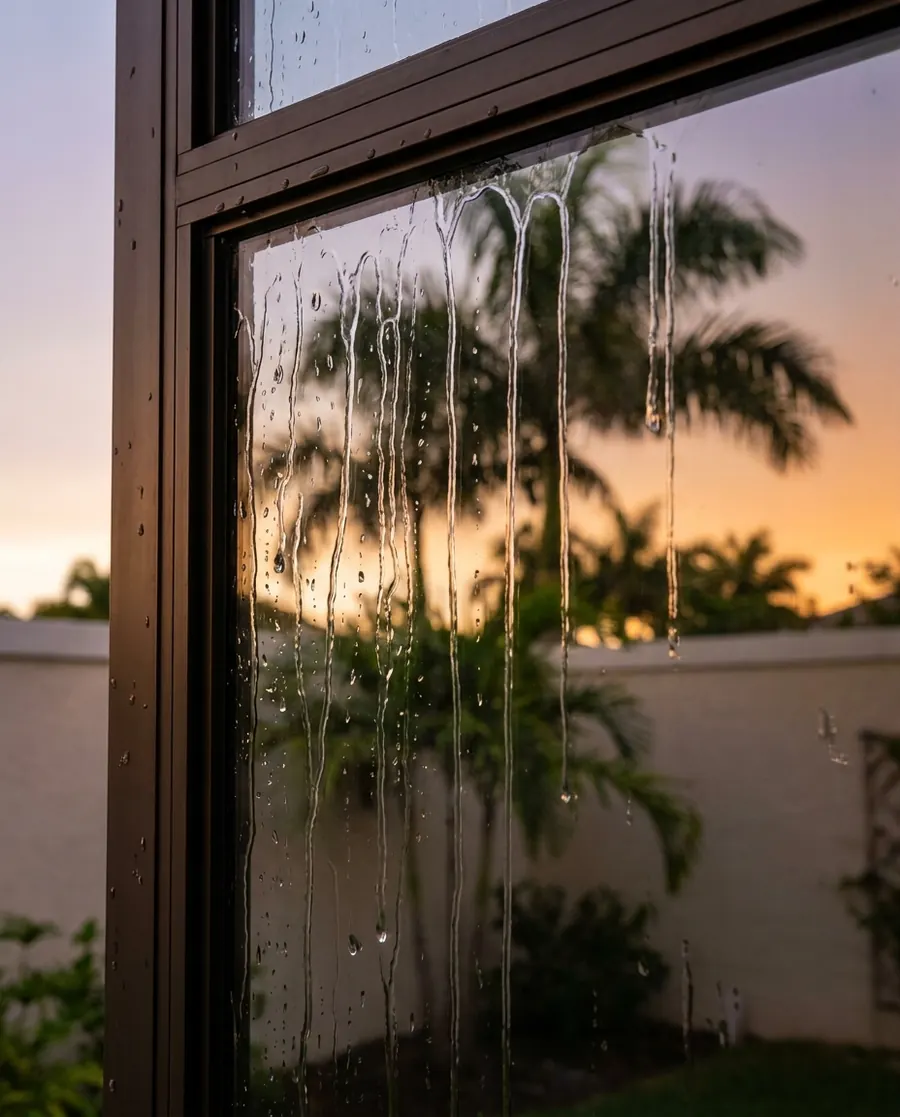
Before a squeegee touches a pane, an exterior cleaner has to answer questions the glass will not answer on its own: whether it is heat treated, whether a coating sits on the outside face, and whether film has been applied to it. The National Glass Association sets out what to do about those questions in Glass Technical Paper FB01-00, updated in December 2023. This page collects what that paper says: the logo that may not be there, the pencil test for an exposed reflective coating, what a razor blade does to unprotected glass, and why glazing materials are not a sufficient barrier against cleaning agents. Exterior window cleaning removes dirt and buildup for a clearer view and brighter property exterior.
The stake
NGA Glass Technical Paper FB01-00, “Proper Procedures for Cleaning Architectural Glass Products,” updated and published in December 2023, states the stake before it states a technique. The National Glass Association writes: “Since glass products can be permanently damaged if infrequently or improperly cleaned, glass producers and fabricators recommend strict compliance with the following procedures for cleaning glass surfaces.”
One of those procedures is a question rather than a movement of the hand: what is this glass? NGA warns that the answer is often not visible. “A logo may not be visible or present on all heat-treated glass products, so the lack of a logo does not mean the glass is not heat-treated.” On heat treated glass, which NGA defines as heat-strengthened or fully tempered, the paper sets a limit: “The use of razor blades should be the last possible option, especially on heat treated glass.” Read together, those two sentences leave one cautious reading of a pane nobody can identify: it may be heat treated, so it is treated as though it were. NGA also strongly recommends a test area, set out in the published method for cleaning exterior glass: a small area of one window cleaned and examined for damage before the rest of the job proceeds.
The coating
One maker publishes where its own coatings sit. Cardinal Glass Industries, a maker of Low-E coated glass, states that its regular Low-E products “are applied to the #2 or #3 surface in a dual pane, and surfaces #2, #4, or #5 in a triple pane IG unit.” By the industry's surface-numbering convention, surface 1 is the outdoor face of a dual pane unit and surfaces 2 and 3 face each other inside the sealed cavity.
That is where Cardinal's regular Low-E products sit. It is not where every coating sits, and NGA says so plainly: “Glass can be clear or tinted and have pyrolytic or sputtered Low-E or reflective coatings, some of which may be on the exposed surface of the glass.” It adds that one kind is particularly hard to spot, because “Low-E coatings are typically neutral in color and very difficult to see.” Looking at a pane may not settle it.
Reflective coatings are the one case the paper gives a field test for, and it takes a pencil and a few seconds. NGA writes: “A simple test to determine the location of the reflective coating is to touch the point of a pencil to the glass surface. If the reflection of the pencil point meets the real pencil, the coating is exposed on that side. If there is a gap between the pencil point and the reflections, the coating is not exposed on that side of the glass.” Anyone can run it on their own window before a cleaner arrives, and what the answer changes is set out in the four kinds of glass an exterior cleaner meets in Naples.
Blades
NGA's position on blades is more careful than a flat ban. Its formal wording is: “While members of NGA neither condone nor recommend scraping of glass surfaces with blades or scrapers for routine cleaning, it is recognized that window cleaners may choose more aggressive techniques, including the use of razor blades, in non-routine cleaning.”
The line between the two is drawn on the metal itself. NGA writes that “During routine cleaning care should be taken to avoid metal contact with the glass surface; razor blades and metal scrapers should not be part of routine cleaning.” The mechanism behind that instruction is small enough to be invisible and obvious once it is named: “In the process of removing tenacious contaminates from unprotected glass, particles may be trapped between the razor blade and the glass, resulting in fine scratches.” In NGA's account the scratching agent is the grit trapped under the blade, not the steel alone.
One line carries no exception at all: “Razor blades should never be used on coated glass surfaces.” Which is why the pencil test above is not an optional flourish. It is how the paper says to locate a reflective coating, and because a Low-E coating can sit on an exposed surface without being visible, a pane that shows a gap has still not been cleared for a blade. FB01-00 also points readers to a separate NGA paper on heat treated glass surfaces before any heat-strengthened or tempered glass is cleaned.
The frame
The sealants, gaskets and tapes that hold a pane in its frame look like a seal. NGA notes that they are not a sufficient one: “Glazing materials do not provide a sufficient barrier to prevent cleaning agents from entering the glazing pocket and damaging the edge of the glass product or affecting the insulating glass unit seal.”
The consequence is stated plainly, and it is worth reading in both directions. NGA writes that “Insulating glass unit longevity may be negatively affected by exposure to certain chemicals.” That is a statement about what the wrong chemistry can do to a sealed unit. It is not a statement that cleaning does anything for one.
Laminated glass has an exposed edge of its own, and impact glass is laminated glass. First on NGA's list of materials that “may cause harm” to it: “Bleach (or other solutions containing sodium hypochlorite)”. The Asphalt Roofing Manufacturers Association's own guidance for algae discoloration on a roof is “a solution of liquid household bleach (sodium hypochlorite) and water”. That is why overspray control on a roof job is a technical requirement rather than a courtesy, and why how soft washing is carried out around a house is a glass question as much as a roof question.
The limit
Some openings carry an applied film, and NGA treats film as its own surface rather than as glass: care not to scratch it, and no bristle brushes or abrasive cleaning materials. On ammonia the paper stops short of a flat rule and routes the question somewhere else: “Cleaning solutions containing ammonia may not be suitable for all film types; check with the film supplier for recommended cleaners.” The supplier who made the film is the one who knows which cleaners it tolerates.
There is also a point past which the published routine does not reach. NGA is candid about one limit and it scopes it: glass that is improperly stored or left unprotected during construction may end up past routine cleaning procedures, and the paper then names razor blades, chemical cleaning and mechanical polishing as the more aggressive techniques that may become necessary. What the Gulf leaves on a window between cleanings is a different question, and it is taken up in what the Gulf coast does to a window.
Everything above happens before the work starts. NGA's pure water specification is in pure water and the water-fed pole, and what the association and a window maker publish about how often to clean is printed on frames, drainage and coastal glass. Windows are one of the three surfaces 239 Exteriors cleans. All of it is settled before the first drop of water lands, which is why the identification comes first and the technique second.
Terms
The words the trade uses on this page, each in a sentence or two. More of the trade's terms are defined one per page in the glossary.
Often not by looking. The National Glass Association writes that “A logo may not be visible or present on all heat-treated glass products, so the lack of a logo does not mean the glass is not heat-treated.” Its instruction follows: “The use of razor blades should be the last possible option, especially on heat treated glass.”
NGA publishes a pencil test in FB01-00, and its own words scope that test to the reflective coating: “If the reflection of the pencil point meets the real pencil, the coating is exposed on that side.” A gap between the two means it is not. A Low-E coating is harder. NGA calls it “typically neutral in color and very difficult to see.”
Two ways a Low-E or reflective coating is put onto glass. NGA writes that glass “can be clear or tinted and have pyrolytic or sputtered Low-E or reflective coatings, some of which may be on the exposed surface of the glass.” That last clause is why a coating cannot be assumed to sit sealed inside the unit.
Because of what travels under it. NGA describes the mechanism: “In the process of removing tenacious contaminates from unprotected glass, particles may be trapped between the razor blade and the glass, resulting in fine scratches.” In NGA's account the scratching agent is the grit trapped under the blade, not the steel alone, and its published technique is written around keeping particles out from under it.
Not on its own. NGA is writing about the sealants, gaskets and tapes a pane is glazed with: “Glazing materials do not provide a sufficient barrier to prevent cleaning agents from entering the glazing pocket and damaging the edge of the glass product or affecting the insulating glass unit seal.” That says what the wrong chemistry does, not what cleaning achieves.
Film is treated as its own surface. NGA writes that “care must be taken not to scratch the film. Do not use bristle brushes or abrasive cleaning materials.” On ammonia it stops short of a flat rule: “Cleaning solutions containing ammonia may not be suitable for all film types; check with the film supplier for recommended cleaners.”
Sources
Every technical statement above is drawn from one of these documents. Nothing on this page about 239 Exteriors goes beyond what the company itself states.
Page reviewed September 27, 2026. Florida statutes are quoted from the 2026 Florida Statutes; every image on this page is a labeled concept illustration, not a photograph of a completed job.
Keep reading
What we do
What each of the three services covers, in the company's own words, and where an exterior cleaner's job stops.
Read itThe method
Low pressure plus a cleaning solution, what the roofing bulletins say about a pressure washer, and what each maker publishes instead.
Read itFree estimate
Call 239-500-WASH, or send the form and 239 Exteriors will follow up.
Free estimate
Tell us which surface you are asking about and anything about the property that helps.
Request received
Your request is in. 239 Exteriors will follow up with a free estimate. Need to reach us sooner? Call 239-500-WASH.
The form did not send
Nothing was lost, but this request did not go through. Call 239-500-WASH and we will take the details by phone, or try the form again in a moment.
Request received
Your request is in. 239 Exteriors will follow up with a free estimate. Need to reach us sooner? Call 239-500-WASH.
The form did not send
Nothing was lost, but this request did not go through. Call 239-500-WASH and we will take the details by phone, or try the form again in a moment.